



Progressed Synastry vs Natal Synastry: Key Differences Explained

What Is Natal Synastry?
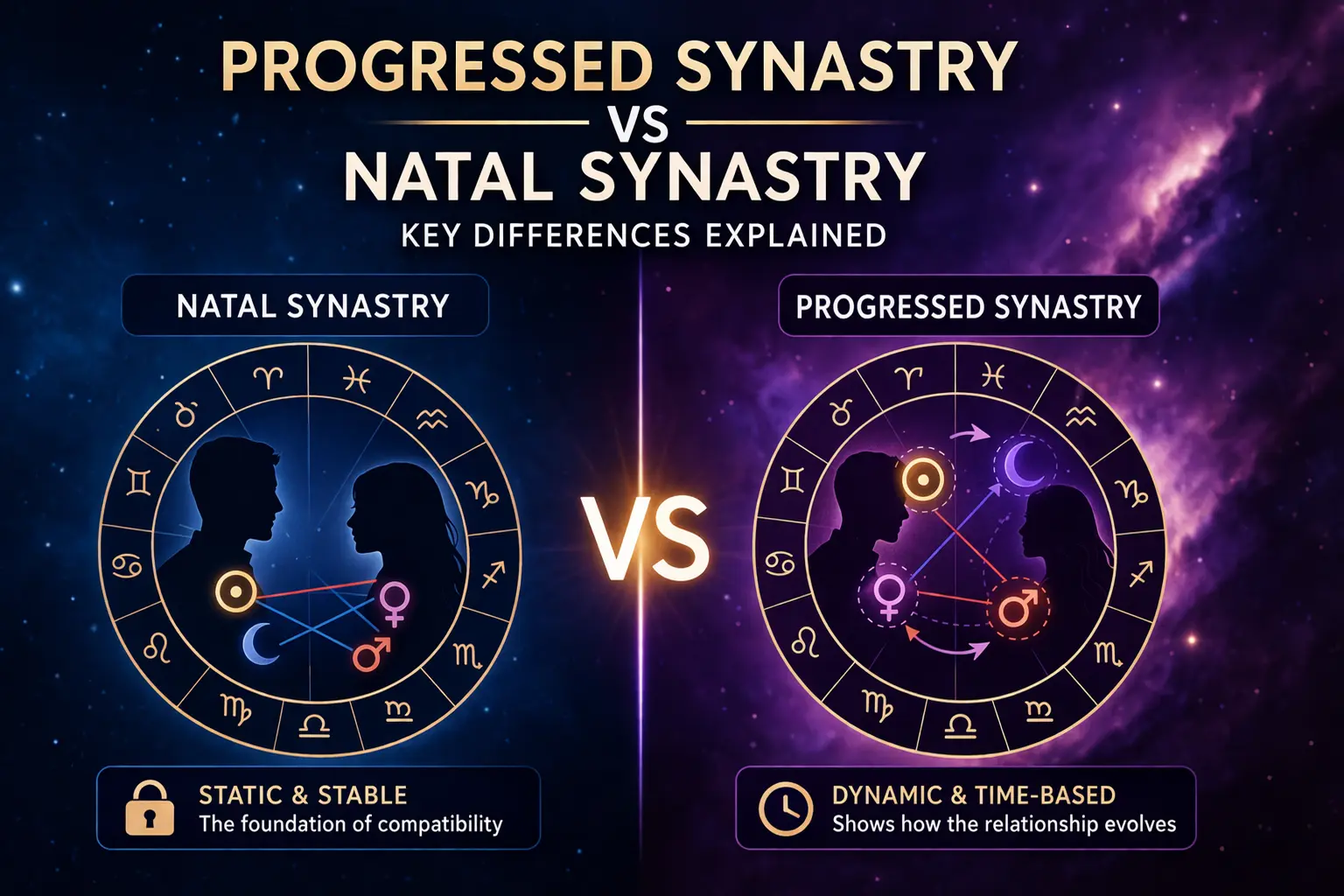
Natal synastry compares two birth charts to analyze the natural compatibility between individuals. It reveals how two people interact on a fundamental level, including emotional connection, communication style, attraction, and long-term potential.
Because natal charts never change, natal synastry represents the stable foundation of a relationship. It shows the core dynamics that exist regardless of time, circumstances, or external influences.
If you are new to this concept, you can explore the full synastry system here: Synastry lessons and fundamentals.
What Is Progressed Synastry?
Progressed synastry compares the progressed chart of one or both individuals with the natal chart of the partner. Unlike natal synastry, it reflects how a relationship evolves over time as each person develops emotionally and psychologically.
Progressions simulate the internal growth of a person, showing how needs, perceptions, and emotional responses shift. When these changes interact with another person’s chart, the relationship dynamic also changes.
To understand this process in more depth, explore the full progressed synastry guide.
Key Differences Between Progressed and Natal Synastry
- Nature: Natal synastry is static, while progressed synastry is dynamic and time-based.
- Purpose: Natal shows compatibility; progressed shows development and change.
- Timing: Natal has no timing factor; progressed reveals relationship phases.
- Stability: Natal aspects remain constant; progressed aspects form and fade.
In simple terms, natal synastry answers “Are we compatible?”, while progressed synastry answers “What is happening between us right now?”.
How Natal Synastry Shapes Relationship Foundations
Natal synastry creates the baseline for how two individuals relate to each other. Strong Venus, Moon, and Sun connections often indicate attraction, emotional bonding, and mutual understanding.
Challenging aspects, such as squares or oppositions, can create tension but also drive growth. These patterns remain present throughout the relationship, even when circumstances change.
This is why some relationships feel naturally easy, while others require effort and adjustment over time.
How Progressed Synastry Shows Relationship Changes
Progressed synastry highlights when and how relationship dynamics shift. For example, a progressed Moon changing signs can indicate a new emotional phase, while a progressed Venus aspect may bring attraction or distance.
These changes often explain why a relationship evolves, improves, or becomes more challenging over time, even when natal compatibility remains the same.
Many of these emotional shifts become especially visible through progressed Moon contacts and changing emotional cycles. You can explore this in more detail here: Progressed Moon synastry and emotional timing .
- New emotional needs may emerge
- Communication patterns can shift
- Attraction levels may increase or decrease
- Conflicts may appear or resolve
How to Evaluate the Most Important Planets in Synastry
One of the key steps in understanding both natal and progressed synastry is knowing which planets matter the most in relationship analysis. Not all planetary contacts carry equal weight, and focusing on the most relevant ones can significantly improve interpretation accuracy.
In most cases, the personal planets—especially the Sun, Moon, Venus, and Mars—play a central role. These planets directly reflect identity, emotional needs, attraction, and action within a relationship. When these planets are activated through progression, the relationship often enters a noticeable new phase.
For example, a progressed Venus aspect can indicate increased affection, romantic interest, or a shift in values, while a progressed Moon often acts as a trigger for emotional change and new experiences. In astrology, progressed aspects are particularly important when they form close connections to natal planets, as these interactions tend to mark meaningful periods of development.
However, simply identifying aspects is not enough. You also need to evaluate which planets are dominant and how they interact within the overall chart. A strong Venus connection may not produce the same result if Saturn is heavily involved, adding restriction or responsibility to the relationship dynamic.
If you want to go deeper into how to identify the most influential planets in relationship astrology, see this lesson: Evaluating the Best Planets in Synastry.
By combining this approach with progressed synastry, you can better understand not only what is happening in a relationship, but why certain periods feel more intense, meaningful, or challenging than others.
Which One Is More Important?
In long-term relationship analysis, astrologers often combine synastry with composite charts and progressed relationship cycles to understand both compatibility and relationship evolution. synastry chart interpretation example
Neither system is more important than the other. They serve different purposes and must be used together for a complete understanding of a relationship.
Natal synastry provides the foundation, while progressed synastry explains the timing and evolution of that foundation.
Ignoring one of these approaches can lead to incomplete or misleading interpretations.
When to Use Progressed Synastry vs Natal Synastry
- Use natal synastry to understand compatibility and long-term potential
- Use progressed synastry to analyze current relationship phases
- Combine both for accurate interpretation and timing
For example, if a relationship feels different than before, progressed synastry can explain the change, while natal synastry explains why the connection still exists.
Common Mistakes When Comparing Both Methods
- Relying only on natal synastry and ignoring timing
- Overanalyzing progressed aspects without considering the natal base
- Expecting progressed synastry to override core compatibility
- Interpreting temporary phases as permanent outcomes
A balanced approach avoids these mistakes and provides a clearer picture of relationship dynamics.
Conclusion
Natal and progressed synastry are complementary tools in astrology. While natal synastry shows the foundation of a relationship, progressed synastry reveals how that foundation evolves over time.
By understanding both methods and applying them together, you can gain deeper insight into compatibility, timing, and the natural cycles that shape relationships.
Want to Study Synastry in Greater Depth?
Join the Free Synastry Course and explore relationship astrology through structured lessons.
Join the Free Synastry CourseWant a Personal Astrology Reading?
Get a personal astrology consultation based on your own chart.
Get a Personal Reading