


Astrological Signs: Complete Guide to Zodiac Symbols and Their Meanings
Astrological Signs as the Second Layer of the Astrological Script
Astrological signs represent the second component of the astrological language. There are twelve of them, and they define the basic roles that planets, as active factors or “actors,” assume. Unlike planets, signs are static in nature and primarily color the overall expression. Each planet rules a specific sign, which establishes a strong affinity between the planet and its “own” sign. The difference lies in the fact that the planet is active and represents a condensed form of the sign—a concentrated essence of the sign itself.
This lesson is part of the Astrology Foundations pillar, which explains how planets, signs, houses, and aspects function together as a symbolic language. The role of planets as active principles is explained in more detail in planetary principles and advanced planetary functions.
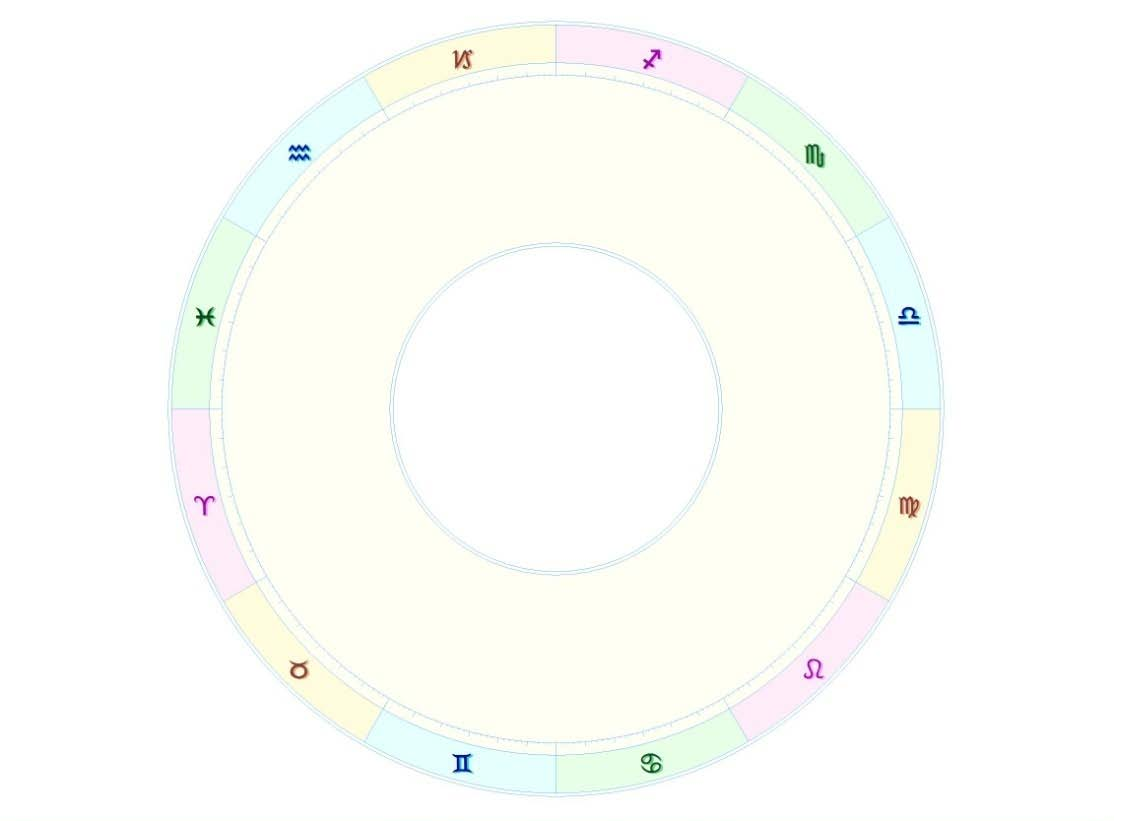
The twelve signs form a complete circle of 360 degrees, with each sign occupying 30 degrees. A planet, however, can exist at only one specific degree, where its energy is concentrated. Signs are therefore far more diffuse than planets and considerably weaker in terms of direct influence. They represent the psychological background, the inherited pattern or inner code that speaks through us. Signs describe the planet by pointing to what is contained within it—toward ancient layers of experience and the distant past.
Zodiac Signs and Constellations: A Necessary Distinction
Zodiac signs should never be confused with constellations. Although they share the same names as the constellations, they do not correspond to the actual star formations in the sky. The zodiac is a symbolic system, not an astronomical map, and its signs function as abstract segments of the ecliptic rather than physical groupings of stars.
Oppositions and the Principle of Complementarity
Each sign understands what is familiar to it—its own nature—but does not naturally understand its opposite, the sign positioned directly across from it in the zodiac. Aries does not easily comprehend Libra, Taurus struggles to understand Scorpio, and so on. The most essential task for every sign is to recognize and accept its opposite, a principle that becomes especially important when analyzing slow-moving influences such as outer planets and their retrograde motion.
For a sign to truly know itself, it must integrate everything represented by its opposing sign and accept the qualities that opposition embodies. This principle of polarity is fundamental to astrological interpretation and psychological development.
Planetary Rulerships of the Zodiac Signs
Each sign is further described and refined by the planet or planets that rule it. Every zodiac sign is governed by a specific planetary force, and in some cases by two rulers, a topic explored deeper in planetary meanings and solar principles.
Each sign is further described and refined by the planet or planets that rule it. Every zodiac sign is governed by a specific planetary force, and in some cases by two rulers:
- Aries – Mars
- Taurus – Venus
- Gemini – Mercury
- Cancer – Moon
- Leo – Sun
- Virgo – Mercury
- Libra – Venus
- Scorpio – Mars and Pluto
- Sagittarius – Jupiter
- Capricorn – Saturn
- Aquarius – Uranus and Saturn
- Pisces – Jupiter and Neptune
Classification of Zodiac Signs
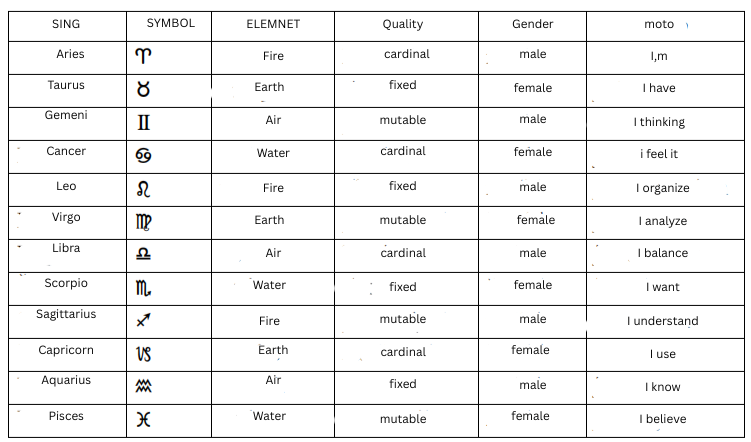
The twelve zodiac signs can be classified into specific groups based on three primary criteria:
- Element
- Quality
- Polarity (Gender)
Elements and Temperament
The element of a sign represents the basic nature and temperament of the individual. Signs are divided into Fire, Earth, Air, and Water, each corresponding to a distinct psychological temperament.
A person with a dominant Fire element tends toward a choleric temperament—energetic, impulsive, explosive, and action-oriented. Strong Earth emphasis corresponds to a melancholic temperament—slow, reflective, and oriented toward the past. Air dominance reflects a sanguine temperament, marked by adaptability and social responsiveness. Water dominance aligns with a phlegmatic temperament—calm, withdrawn, and emotionally sensitive.
Based on elemental emphasis, individuals can be classified into four fundamental psychological types. While melancholic and phlegmatic temperaments may incline toward depressive states under challenging conditions, choleric and sanguine temperaments are primarily associated with vitality and outward engagement.
Polarity: Masculine and Feminine Signs
According to polarity, signs are divided into masculine and feminine. Fire and Air signs are considered masculine, while Earth and Water signs are feminine. In the zodiacal sequence, signs alternate consistently between masculine and feminine—for example, Aries followed by Taurus, Gemini followed by Cancer.
Qualities: Modes of Action and Response
The quality of a sign describes its fundamental mode of operation and response to circumstances. There are three qualities: Cardinal, Fixed, and Mutable.
Cardinal Signs: The Principle of Initiation
Cardinal signs mark the beginnings of the seasons. Aries initiates spring and the entire zodiacal year. Cancer marks the beginning of summer, Libra the beginning of autumn, and Capricorn the beginning of winter.
These signs are associated with initiative, leadership, sudden action, and beginnings. Aries, as the first cardinal sign, represents the most immediate and forceful initiation. Planetary placements in Aries often become dominant life themes.
The difference between Aries and Capricorn as initiators lies in timing: Aries signifies beginnings earlier in life, while Capricorn represents beginnings later in life. Libra often describes beginnings emerging through relationships, typically in the second half of life.
Fixed Signs: Stability and Continuity
Fixed signs are responsible for stability, endurance, and persistence. Unlike cardinal signs, which act quickly but briefly, fixed signs operate slowly but create lasting structures.
In health symbolism, cardinal signs are associated with acute conditions that arise suddenly and pass quickly, while fixed signs correspond to chronic conditions that develop gradually and persist over time. In financial symbolism, cardinal signs suggest rapid gain and loss, whereas fixed signs indicate slower but stable and lasting income.
The essential function of fixed signs is to preserve and stabilize what has already begun.
Mutable Signs: Transition and Adaptation
Mutable signs lie between cardinal and fixed signs in quality. They are the least stable, but their role is not stability—it is transition, connection, and communication between different states.
Using the example of spring: Aries announces the beginning of spring, Taurus stabilizes it, and Gemini signals the transition toward summer. Mutable signs are not representatives of a state but indicators of change.
When matters such as marriage are placed in mutable signs, this often suggests instability or a transitional function—sometimes indicating that a partner serves as a bridge toward another relationship.
Element and Quality as a Combined Code
Each sign contains a specific code composed of its element and quality:
4 Elements × 3 Qualities = 12 Zodiac Signs
For example, fixed water corresponds to Scorpio, mutable water to Pisces, and cardinal water to Cancer. Fixed fire is Leo, cardinal fire is Aries, and mutable fire is Sagittarius. Each sign can thus be described precisely through the interaction of its elemental and qualitative principles.
Examples of Water Signs by Quality
Fixed water represents emotional stability and intensity. These emotions are enduring, focused, and powerful. Since water is not naturally fixed, emotions associated with Scorpio can become heavy, excessively intense, and often negative.
Mutable water, represented by Pisces, indicates gentle but unclear, elusive, and unstable emotions. Cardinal water, represented by Cancer, describes emotions that develop rapidly but also diminish quickly and pass.
Want a Personal Astrology Reading?
Get a personal astrology consultation based on your own chart.
Get a Personal ReadingIf this lesson was helpful, you may support the work and help keep all content freely available.
Support the Work