


Why the Natal Chart Matters More Than Synastry in Relationship Astrology
Why the Natal Chart Comes Before Synastry Analysis
Approximately 80% of relationship astrology is represented by the natal chart. Every person with whom we create relationships, the relationships themselves, their characteristics, and their overall disposition already exist and live within our natal horoscope. For this reason, a synastry chart or relationship chart should never be evaluated before the natal chart has been properly assessed.
The most important step is determining who is represented by whom in the horoscope—that is, identifying which planets symbolize specific people. Only after this foundation has been established should the synastry or relationship chart be examined in greater detail. For a broader understanding of this approach, study the Synastry lessons.
The most common mistake astrologers make is assigning greater importance to the synastry chart or relationship chart than to the natal chart. As a result, comparing two horoscopes may indicate an excellent astrological combination while the individuals involved feel absolutely nothing for one another. The reason is that these people simply do not exist within each other's natal symbolism.
For example, if we are heterosexual and encounter a person of the same sex with whom we share excellent synastry aspects, we will not experience romantic attraction. Likewise, if we are homosexual and encounter someone of the opposite sex under the same conditions, the result will be similar. The same principle applies if someone significantly older or younger appears with whom we have outstanding synastry aspects, yet our natal chart contains no symbolism for a relationship with a person of that age. Before anything else, it is necessary to determine whether that person actually lives in our horoscope, because without this, synastry and relationship charts become unnecessary.
The Planet Representing the Relationship
For a relationship to succeed, excellent synastry aspects alone are not enough. The person must also be represented in our natal chart by a planet through which we are capable of establishing a close emotional bond.
If the individual with whom we have an excellent synastry combination is represented by a planet of minor importance—one that is not connected with emotional factors, is poorly placed, or has an unfavorable disposition (indicating the eventual outcome of the relationship)—then the relationship will neither become significant nor successful.
Every relationship, every bond, has its own nature expressed through the planet that represents it in the horoscope. In some relationships we feel fulfilled because they are represented by a well-placed planet, while in others we feel as though we are not living our own lives because they are represented by a difficult planet.
Such relationships are often best avoided before we become emotionally attached. Alternatively, if we are sufficiently aware, we may consciously transform a difficult relationship into something meaningful. In every relationship, we are ultimately relating to our own planet. When that planet is heavily afflicted, there is a possibility of serious disappointment, but there is also an opportunity to correct something difficult, making the eventual reward greater. However, such a relationship requires considerable personal energy.
Finding the Right Person in the Natal Chart
It is important to determine which planet in the horoscope is best connected with the series related to emotions and relationships, because that planet represents the true partner for the native. After identifying it, its activation through directions and progressions should be monitored, since only then does it become meaningful to study the relationship chart itself.
Studying a relationship chart with someone is entirely pointless if that individual is not truly the person indicated within our own natal story. A deeper explanation of identifying the correct planetary significator can be found in Evaluating the Best Planet in Synastry.
It is possible for a person to be represented by a planet that the chart owner naturally likes, yet that planet may occupy a sign unfavorable for the native, form aspects that threaten the native, or possess a very poor disposition. In such cases, we cannot speak of a healthy or high-quality relationship regardless of how favorable the synastry aspects or relationship chart may appear.
Synastry charts primarily indicate karmic relationships and the closeness that exists because of unconscious memory. Every aspect, especially conjunctions between planets, speaks of past-life relationships, while conjunctions in particular point to especially important former connections. However, these relationships do not necessarily represent the primary relationship of the current lifetime.
It is similar to meeting a former spouse from a previous life while our attention in this life is directed toward someone else. Exact conjunctions indicate important messages received through another person, and they may indeed point to an important present-day relationship, but this must always be confirmed through the symbolism of the planet that represents that individual in the native's natal chart.
Factors That Play a Role in Relationships
The planet that primarily describes a person's ability to unite with another individual, the manner of that union, and the relationship itself is, besides Venus as the essential significator of relationships, the ruler of the Descendant.
The ruler of the Descendant functions as one's personal Venus. Through the ruler of the 7th house, we discover everything that can be called our partner in this lifetime. It acts as a Venus that expresses the unique nature of whichever planet rules the 7th house.
The stronger the ruler of the Ascendant, the less awareness a person tends to have of others, which may create difficulties in forming relationships. A powerful Ascendant ruler resembles an emphasized Mars, making the individual more inclined toward self-initiation and less oriented toward others.
When the 1st and 10th houses are excessively emphasized—the 10th being the exaltation of the 1st and representing the individual—or when the eastern side of the horoscope is dominant, the personality becomes so emphasized that relationships become more difficult to understand.
Conversely, individuals with an emphasized western hemisphere and a strong 7th-house series may experience the opposite problem. They often lack a clearly defined identity, can become weak, and change according to the partner they are with. Healthy relationships require balance: the ability to define ourselves while also becoming flexible enough to move between individuality, represented by the 1st house, and partnership, represented by the 7th house.
The Meaning of Series 7 in Relationship Astrology
Series 7 describes the destiny and nature of relationships in the horoscope, with the ruler of the 7th house serving as its most significant indicator.
Regardless of an individual's psychological profile, a poorly positioned Series 7 indicates difficulties with connection and relationships. It is possible for a psychologically difficult person to possess a strong 7th-house series and therefore establish relationships with ease while attracting pleasant partners. At the same time, a kind and gentle individual with a weak Series 7 may repeatedly attract harsh partners.
This reflects the soul's need in this lifetime to attract a relationship that remained fundamentally unresolved so that it may finally be corrected. Relationships are therefore independent of our psychological personality. The 7th house represents our dispositor, our second chance, and ultimately our judgment and destiny. For additional insight into the deeper purpose of these connections, see Relationship Frequency and Karmic Connections.
Venus Versus the Descendant Ruler
The difference between Venus as the natural significator of relationships and the ruler of the Descendant lies in the fact that the Descendant ruler gradually assumes more and more of its essential planetary nature over time.
For example, if Saturn rules the 7th house and is conjunct Venus, this describes a marriage filled with love because the ruler of the 7th receives Venus. However, as Saturn increasingly expresses its own essential nature over time, the marriage may gradually lose affection, closeness, and joy.
If Jupiter rules the 7th house and is conjunct Venus, we would speak of great love within marriage, yet affairs are likely to develop over time. If Uranus rules the 7th house, it describes a sudden marriage, an unusual and romantic love story, but also the possibility of divorce because Uranus eventually expresses its own essential Uranian nature.
The sign of Libra says relatively little about the native's personal relationships themselves. Instead, it speaks more about inherited predispositions for forming relationships and should therefore be considered only as an additional factor.
Series 4 and Its Role in Relationship Astrology
In addition to Series 7, another important factor influencing relationships is Series 4. While the 1st and 10th house angles represent the native, the 7th and 4th house angles describe relationships.
The 4th house represents genetics, the people closest to us, as well as the home and family environment in which certain relationship patterns existed and were inherited by the native. Understanding this foundation helps place relationship symbolism into its proper context, together with the principles explained in how to read a synastry chart.
The 5th house describes closeness at the deepest level, symbolized by the umbilical cord and the bond with the mother. Therefore, the depth of any relationship is evaluated according to how well Series 4 integrates with Series 7. If Series 4 is well positioned and connected with Series 7, there is strong potential to enter deeply intimate and meaningful relationships. The people we experience as truly close are perceived primarily through Series 4.
If both Series 4 and Series 7 are poorly positioned in the natal chart, there is a tendency to attract karmic enemies and very little chance of successfully completing those relationships. In order for relationships to reach fulfillment, there must be at least some positive symbolism within these two series, and they must be well connected.
The relationships described by Series 7 include all forms of partnership—legal, marital, business, and even open enemies. These relationships do not necessarily imply emotional depth and are generally much more superficial than those described by Series 4, which governs relationships that are intimate, deeply emotional, irrational, and highly personal. Through Series 7, we attract all types of relationships.
If a relationship operates through Series 4—that is, if the planet representing the relationship is connected with Series 4—it indicates a relationship that, depending on the aspects involved, may be either positive or difficult, but is connected with ancestral merit or inheritance. Such relationships often appear completely irrational, illogical, and beyond conscious control.
Venus represents Series 7, while the Moon represents Series 4. Together they form the essential symbolism for a close relationship. Venus provides the capacity to experience love and attraction, especially physical attraction, while the Moon allows us to experience emotional closeness and depth.
Combining Series 4 and Series 7
Every planet that forms aspects with factors belonging to Series 4 or Series 7 becomes part of the possible framework of people with whom we enter emotional relationships. Series 7 contributes beauty and attraction, while Series 4 contributes closeness and emotional depth. A relationship becomes truly fulfilling to the extent that it satisfies both of these principles.
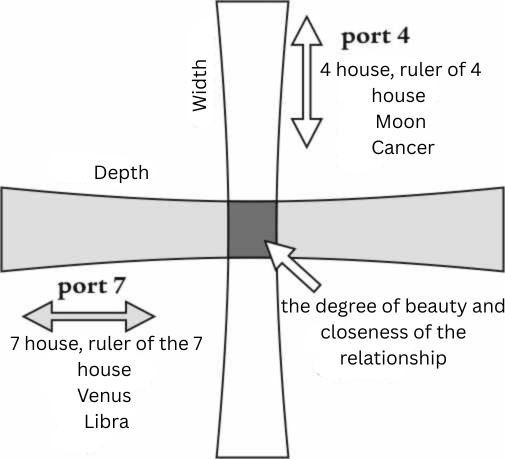
Every horoscope contains certain planets that are favorably connected with Series 4 or Series 7, and others that are not. It is important to determine whom each of these planets represents in order to understand the potential of the relationship they symbolize. A broader explanation of relationship planets can be found in which planets matter most in synastry.
If the goal is a stable and lasting relationship, it is also essential that the dispositor of the planet representing the partner be well placed.
Every horoscope contains at least one planet that, either through its aspects or through its placement in a sign harmonious with the Ascendant ruler, describes the partner with whom the native can experience the most pleasant relationship and reach the highest relationship potential promised by the natal chart.
This is usually the planet with the strongest position and the best disposition. Its activation through progressions indicates the period when the ideal partner is likely to appear.
If that planet forms several natal aspects, different events and different partners may appear through the symbolism of those aspects. However, the "right person" appears only when the appropriate atmosphere required by that planet is created, through a change of sign in directions or progressions together with the corresponding transits.
Series 5 as the Principle of Love
Series 5 is also an important relationship factor, although it does not represent the relationship itself. We love through the 5th house, and everything found in the 5th house becomes something we love. The 5th house represents love itself rather than partnership.
Through the 5th house we experience happiness, and it does not necessarily have any connection with Series 7. However, when these two series are connected, they describe happiness within relationships and love expressed through relationships.
The ruler of the 5th house functions as the native's "organ of love," regardless of which planet serves this role or where it is located. The house occupied by the 5th-house ruler describes affection toward everything symbolized by that house, whether it refers to a particular life area or a specific person.
Likewise, the aspects formed by the ruler of the 5th house describe love toward the planet involved in the aspect, as well as happiness experienced through that planet. A difficult aspect from the ruler of the 5th still indicates love, but primarily points to problems in love or difficulties expressing love.
A favorable combination between Series 5 and Series 7 is the classic formula for love, especially in synastry charts. This occurs, for example, when the ruler of the native's 5th house forms a harmonious aspect with the partner's 7th-house ruler, and vice versa, creating emotional circulation between both charts.
The combination of Series 4 and Series 5 represents closeness and love, but this symbolism is primarily connected with family and conception. Venus, which represents the magical quality of romantic love, is not part of this combination.
A planet with a good natal position but a poor disposition indicates that something once deeply loved may eventually develop into intolerance or even hatred.
The love we give is shown through the 5th house, while the love we receive is shown through the 11th house. These two are often not equal. In any case, it is better to give more love than to receive more, because giving, creating, and expressing love bring greater happiness than merely receiving it.
People color and enrich their lives through relationships, and the quality of life depends largely on the planet through which they experience those relationships. By entering into a relationship with another person, we actually unite with the planet that represents that individual within our own horoscope, and we begin living primarily through that planet, which we ourselves have attracted.
Marriage to another person is, in essence, marriage to our own planet represented by the ruler of the 7th house or by the planet aspecting the ruler of the 7th house. Understanding the quality of these planetary connections is essential when evaluating the most important synastry aspects.
Want a Personal Astrology Reading?
Get a personal astrology consultation based on your own chart.
Get a Personal ReadingIf this lesson was helpful, you may support the work and help keep all content freely available.
Support the Work