



Synastry Aspects and Relationship Patterns: How to Read a Synastry Chart
Synastry and the Formation of a Third Entity
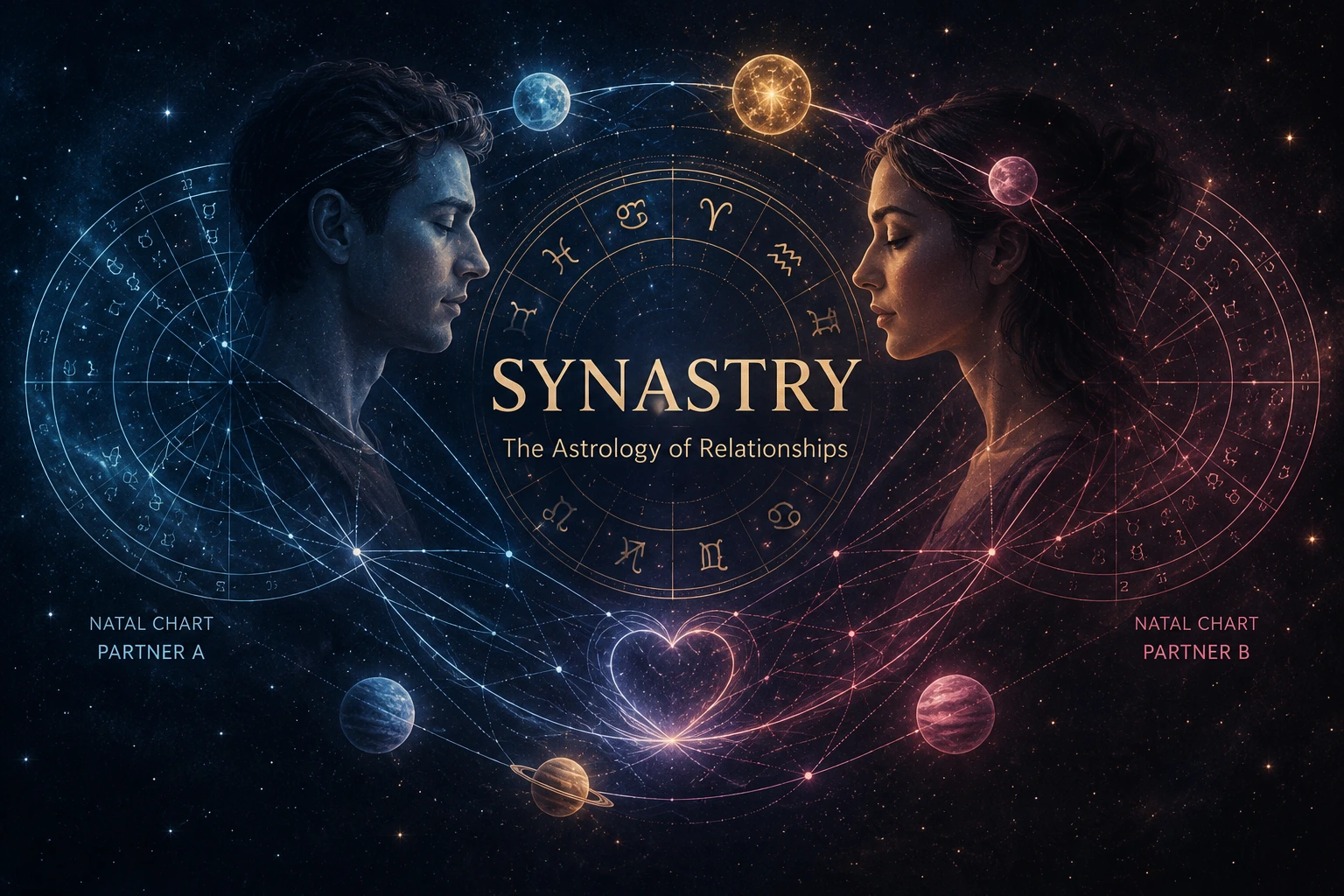
The central principle of this approach to synastry is that the interaction between two natal charts creates something more than a simple exchange between two individuals. The aspects formed between the charts describe a third entity that develops within the relationship and eventually acquires its own character. Understanding this emerging entity is therefore one of the most important tasks in synastry. The initial distinction between whose planet is involved remains useful at the beginning, because it shows where the interaction originates, but as the relationship continues, the planetary symbolism becomes increasingly shared. This perspective is fundamental to the study of synastry interpretation.
Consider, for example, a Mars–Venus square between two partners. At first, the person represented by Mars may experience the Venus person as irritating or emotionally hurtful. With time, however, the pattern can reverse. The person who initially experienced the Mars–Venus tension may eventually express the Mars quality toward the other person. The important point is no longer simply identifying whose natal chart contains Mars and whose contains Venus. The aspect has become a characteristic of the relationship itself.
This principle is especially important when considering the symbolism of the Moon and Venus in a partnership. In a relationship between a man and a woman, the planetary symbolism traditionally associated with the feminine principle can become part of the woman's experience through the man's chart. His Venus and Moon therefore have particular significance for understanding the woman's role within that relationship. Venus may describe the initial experience of attraction and the feminine image, while the Moon can become increasingly relevant as the couple shares a home, family life and a deeper domestic environment.
Reading the Relationship as a Shared Entity
Once significant aspects appear between two charts, particularly very close aspects and conjunctions, the astrologer should begin identifying the entity that they create together. The relationship is not simply the sum of what each person contributes independently. The planetary symbolism becomes mixed through continued interaction and eventually operates as something shared by both participants.
If, for instance, one person's Moon is seriously afflicted in the synastry, the consequences should not be limited to that individual's emotional experience. The Moon also signifies the home, the mother, family relationships, private life, one's inner world and the land or environment in which one lives. Consequently, the relational manifestation of a difficult lunar pattern may involve these broader areas as well. The question is not merely who owns the Moon, but what the lunar symbolism becomes within the shared life of the two people.
This is why the astrologer should identify the principal entities created by the synastry and determine which configurations establish the dominant story. The initial planetary ownership provides the starting point, but the relationship gradually develops its own structure. The task is to interpret that structure as a meaningful pattern rather than treating every aspect as an isolated interaction between two natal planets.
Which Synastry Contacts Become Active First?
The order in which synastry factors become noticeable is important. The first consideration should be the closest aspects, especially exact contacts and conjunctions, followed by the involvement of the personal planets. The relative importance of these factors must still be judged according to the individual chart comparison, because no single mechanical ranking can replace interpretation.
An exact conjunction involving personal planets, particularly one involving the Moon or another strongly personal planet, can establish an especially powerful initial pattern. These contacts are experienced more directly because the planets involved describe immediate human experience. Other planetary layers may become apparent later as the relationship continues.
This means that a relationship can contain several levels of manifestation. The closest personal contacts may describe what is experienced first, while contacts involving more distant planets may require time before their significance becomes obvious. The relationship therefore unfolds progressively, with different parts of its symbolic structure becoming active at different stages. The relative importance of exactness, conjunctions and planetary involvement can be examined more closely through which synastry aspects matter most.
The Natal Roles Behind the Synastry
Before interpreting the interaction between the charts, it is necessary to understand what each planet represents within the individual natal horoscope. In a man's chart, for example, the condition of Venus and the Moon can become highly relevant to the woman who enters a partnership with him. Initially, the woman may be experienced through his Venus symbolism, while the Moon can become increasingly significant if the relationship develops into shared domestic or family life.
This natal foundation should be understood before moving into the detailed synastry. The astrologer needs to know which planetary symbolism describes the person's role in the relationship before determining how the other chart activates it. Only then can the resulting interaction be interpreted with sufficient precision.
Once the analysis moves into synastry itself, the next question is what kind of relational entity develops from these natal roles. Personal-planet contacts tend to establish the first layer, while contacts between personal planets and slower planets can become increasingly important as the relationship progresses.
How Tense Synastry Aspects Become Mutual
Tense aspects such as squares and oppositions involving a slower planet can produce reactions that are not immediately conscious. The person may feel that the partner is doing something to them and may respond as though they must protect themselves, even though their own behavior is simultaneously contributing to the same pattern.
This mechanism is particularly clear in difficult Moon–Mars contacts. Suppose a man's Moon forms a difficult aspect with a woman's Mars. He may initially experience her behavior as rough, insensitive or unnecessarily forceful. She may not intend to hurt him at all; her Mars may simply operate spontaneously and directly. Yet his emotional response can gradually alter the way he behaves toward her.
As the pattern develops, he may begin responding with Mars himself. The woman who originally expressed the Mars symbolism becomes the recipient of his increasingly forceful behavior. The original division between “Moon person” and “Mars person” therefore becomes less useful as an explanation of the established relationship. The relationship itself has become a Moon–Mars pattern in which both participants contribute to its expression.
This can also affect the man's perception of the woman. The Moon seeks emotional security and, within the framework described here, may respond strongly to qualities associated with Venus and Neptune: femininity, enchantment, happiness, inspiration and the experience of being drawn toward tenderness. If he instead begins to experience the woman primarily through competitive or strongly Mars-like behavior, his perception of her may change. He may respect her less as a feminine partner and enter the same competitive dynamic himself.
The result can be a relationship in which the man becomes increasingly forceful even though the original source of his emotional injury was the woman's Mars. The aspect has ceased to function as a one-way interaction. It has become a shared relational pattern that can intensify through repetition.
Exact Aspects and the Dominant Relationship Pattern
The astrologer must therefore identify which of the relational entities are primary. Exact aspects, exact conjunctions and contacts involving personal planets deserve particular attention because they are likely to establish the most immediate and concentrated layer of the relationship.
A conjunction is generally the strongest aspect in this framework, particularly when it is exact. Nevertheless, exactness itself is an important factor regardless of aspect type. It is not always possible to state that a conjunction will automatically dominate another aspect. A very close conjunction may be exceptionally powerful, but if the conjunction is considerably wider while another aspect is exact, the exact aspect may have greater practical weight.
The planets involved must also be considered. An exact contact between personal planets, especially the Moon and Venus, can have a particularly strong relational expression because these planets describe fundamental experiences through which people initially encounter one another. The correct interpretation therefore comes from combining aspect type, exactness and planetary involvement rather than applying a rigid hierarchy.
The Relationship as a New Birth
The entity produced by two people entering a relationship can be understood as something distinct, with its own recognizable character. Its symbolism may appear predominantly feminine, predominantly masculine, or as a combination of both. What matters is that the relationship develops a dominant pattern that cannot be explained adequately by examining either natal chart in isolation.
Once two people begin sharing their lives, their energies become increasingly interconnected. The relationship begins to function almost like a new birth: a new symbolic structure through which both individuals experience life. Their habits, emotional responses, responsibilities and circumstances become intertwined, and the planetary patterns found between the charts become increasingly tangible.
For this reason, the astrologer should not stop after identifying individual attractions or conflicts. The deeper task is to determine what kind of entity has emerged between the two people, which planetary contacts define it, and which of those contacts become dominant as the relationship develops. The resulting pattern can become the central story through which the entire relationship is experienced.
The significance of this developing process becomes especially important when the relationship continues over an extended period. The initial configuration does not disappear, but later layers can become increasingly visible as the two people share more of their lives. This progressive development is particularly relevant when studying progressed synastry relationships, where the changing activation of relationship patterns can reveal how the experience evolves through time.
The Relationship as a Third Entity
When two natal charts are brought together in synastry, the astrologer is not looking only at two separate individuals. The interaction between their charts produces a third structure: a pattern that develops through the relationship itself. An aspect such as Venus trine Moon, Sun conjunct Jupiter, Sun square Saturn, or Venus square Saturn can therefore be understood as part of the character of the relationship rather than merely as something belonging to one person.
The important task is to identify what kind of entity emerges from the combination of the two charts. In this approach, synastry becomes the study of the relationship as something that acquires its own identity over time. The two people bring their natal potentials into the encounter, but repeated interaction creates a pattern that eventually operates as a shared experience. This is an important foundation for understanding how individual planetary contacts contribute to the relationship as a whole, as explained in this step-by-step synastry chart interpretation example.
For this reason, the astrologer should not become overly concerned with assigning every manifestation to one person. The original ownership of a planet remains relevant because it tells us where the interaction begins, but it does not necessarily describe how the relationship will function after the pattern has become established. The relationship develops its own dynamics, and both people participate in expressing them.
The Ascendant in the Partner's Horoscope
One of the most important ways to examine how two people fit into one another's lives is to study the Ascendant, its ruler, and the dispositor of that ruler in the other person's horoscope. The Ascendant represents the person directly, so its placement in the partner's houses shows where that person's basic presence enters the other's life.
If one person's Ascendant falls into the partner's 5th house, the relationship may strongly emphasize affection, attraction, romance, pleasure and the expression of love. If the Ascendant falls into the partner's 8th house, the contact can be considerably more intense, with greater emphasis on passion, vulnerability, attachment and conflict. These house placements show the field in which one person's presence becomes especially significant to the other. The practical meaning of such placements can be developed further through the study of synastry house overlays.
However, stopping at the Ascendant's house placement gives only the first layer of the analysis. The astrologer must then follow the ruler of the Ascendant. Its position in the partner's chart describes how the person's basic energy functions inside that relationship. The next step is to follow the dispositor of the Ascendant ruler, because this shows where that energy ultimately leads.
Following the Ascendant, Its Ruler and Dispositor
This sequence provides a way to determine whether the partner's horoscope gives the individual sufficient support to express their basic nature. The analysis can therefore proceed in a specific order:
- Locate the Ascendant in the partner's houses.
- Identify the ruler of the Ascendant.
- Determine where that ruler is placed in the partner's horoscope.
- Follow its dispositor.
- Examine the condition and aspects of these factors to determine whether the person's energy is supported or obstructed.
The underlying question is how the individual's energy circulates through the partner's horoscope. When the Ascendant, its ruler and the dispositor are supported, the person may experience the relationship as an environment in which they can function naturally. They may feel that their abilities are able to develop, that they have room to act, and that life moves more easily while they are within the relationship.
This can be very different when the same chain is repeatedly subjected to difficult conditions. A partner may initially appear supportive while a more restrictive factor becomes visible only after the relationship has developed. The effects can then become increasingly obvious because the person's Ascendant energy is encountering resistance within the partner's chart.
When Saturn Becomes a Restricting Factor
Saturn is particularly important in this type of analysis when it forms a difficult aspect to the ruler of the Ascendant. Its influence may not be immediately recognizable, but over time it can become increasingly difficult to ignore. The person may begin to feel controlled, restricted, pressured or unable to live according to their own natural direction.
The specific manifestation follows the nature of Saturn. One person may feel that the partner is constantly limiting their freedom. Another may experience excessive responsibility, inhibition or a sense that spontaneous self-expression is no longer possible. The relationship can gradually become an environment in which the individual feels that their normal energy has been reduced.
The next question is therefore what happens to the dispositor of the Ascendant ruler. If that planet is also placed under significant pressure, the difficulty reaches another level. The problem is no longer simply that a partner occasionally creates frustration. The relationship may engage a deeper layer of the person's life and force attention toward something that requires fundamental restructuring.
Relationships That Require Inner Work
A relationship with this type of configuration does not necessarily correspond to expansion, ease or visible success. Its function may instead be connected with confronting foundations that have not been properly established. The experience can draw the person inward and make them deal with material that has previously remained unresolved.
In this sense, some relationships function as periods of repair. They can reduce the person's outward momentum and redirect attention toward an area of life that requires deeper work. The appropriate response is not necessarily to fight constantly against the experience. The source material describes a movement inward: becoming quieter, examining what has been left unresolved, and working directly on the underlying problem.
Once that work has been completed, the individual may no longer need to remain in the same relational circumstance. The relationship does not have to continue indefinitely simply because it has been significant. Its purpose may be connected with what it activated and what the individual was required to address through it.
Different Types of Relational Experience
Not every relationship produces this kind of demanding experience. The opposite condition is also possible: the partner's horoscope can support the Ascendant, its ruler and its dispositor in a way that allows the individual to function with considerably greater ease.
When these factors are supported, the relationship can feel naturally accommodating. The person does not have to spend the same amount of energy overcoming resistance. Instead, the partner's chart provides an environment in which the individual's basic energy can circulate and develop. In practical terms, this may feel like being able to live more fully through the relationship rather than constantly having to defend one's own direction.
This distinction is important because relationships should not be classified simply as good or bad according to isolated aspects. A difficult relationship may correspond to a period of necessary inner work, while a supportive relationship may allow the individual to use the stronger potentials already contained in the natal chart. The purpose of synastry is to determine what kind of pattern has actually been created.
Repeating Relationship Patterns
The same principle can be extended to the possibility of recurring relational experiences. If a difficult pattern is encountered but its underlying problem remains unchanged, the individual may continue to encounter relationships that activate similar material. The issue is not resolved merely because the person leaves one relationship.
There is an important difference between enduring a difficult experience and actually working through what the experience is revealing. Continual dissatisfaction, blame or resistance does not necessarily change the underlying pattern. The astrological task is to recognize what has been activated, understand the role of the relationship, and respond to the problem in a way that addresses its actual source.
When the underlying issue has been properly addressed, a different relational possibility can emerge. The two people may continue together with a changed dynamic, or the relationship may reach its natural completion. Either way, the important point is that the individual is no longer simply repeating the same unresolved pattern.
This also explains why the natal horoscope remains essential. Synastry does not create an entirely new life structure independently of the natal chart. It activates particular potentials that already exist within each person. The astrologer therefore needs to understand which parts of the individual horoscope can provide the most constructive basis for relationship before evaluating how another person's chart interacts with them.
The Best Expression of the Natal Potential
Every natal horoscope contains areas that can be expressed more constructively than others. In relationship analysis, the question is not only whether another person activates a powerful part of the chart, but whether that activation allows the individual to move toward the most constructive expression of their own horoscope.
This is why the relationship can have such a large influence on a person's life. The interaction creates a continuous exchange of energy, and neither individual remains completely identical to the person they were while living alone. The partner's horoscope becomes part of the environment through which natal potentials are experienced.
Consequently, the astrologer should first understand the strongest relational possibilities within the individual chart and then examine whether the synastry supports or obstructs them. The quality of an aspect cannot be understood properly without considering the larger configuration in which it operates. This is why it is important to distinguish the most influential planetary contacts from those that play a secondary role, as explained in Synastry Aspects: Which Matter Most.
Personal Planets and the Slower Planets
The next important layer of synastry concerns contacts between personal planets and the slower planets, beginning with Jupiter and extending through the remaining slow-moving planets. These contacts should be distinguished from the immediate interactions created by personal planets.
Personal planets describe experiences that can usually be recognized relatively quickly: emotional responses, attraction, desire, thought, communication and direct behavioral reactions. The slower planets operate on a different timescale. When they contact personal planets in synastry, their influence may not be obvious at the beginning of the relationship.
Instead, these contacts can become increasingly apparent through the passage of time. As the two people share more experiences, the slower planetary symbolism can become woven into the relationship's structure. Something that initially seems like a simple attraction, irritation or emotional response may eventually reveal a much deeper pattern.
How Slower Planet Contacts Develop
The difference in planetary speed helps explain why a synastry relationship can change in its expression without the original aspect itself changing. The immediate contacts may describe what the two people notice first, while the slower planetary contacts become more evident as the relationship accumulates experience.
Jupiter and the planets beyond it can therefore introduce a broader and deeper dimension into contacts with personal planets. Their symbolism may gradually influence the direction in which the relationship develops, the circumstances surrounding it, and the deeper meaning that the two people eventually experience through one another.
This creates several layers within the same relationship. The closest personal-planet contacts may establish the first recognizable interaction. The Ascendant, its ruler and its dispositor show how each individual's basic energy functions inside the partner's horoscope. The slower planets then add another level, one that may become increasingly visible as the relationship matures.
For this reason, synastry should not be judged only from the first impression created when two people meet. A relationship can contain planetary layers that require time before their full significance becomes apparent. A structured approach helps the astrologer examine planetary aspects, chart factors and their combined meaning, as described in How to Read a Synastry Chart Step by Step.
The Deeper Relational Pattern
The complete synastry picture therefore emerges by combining the individual charts with the entity created between them. The astrologer first recognizes what each person brings through the natal horoscope, then examines the Ascendant and its ruler, and finally studies the planetary contacts that establish the dominant character of the relationship.
Some relationships primarily provide support and allow an individual's energy to move freely. Others bring pressure that directs attention toward unresolved foundations. Still others may begin through immediate personal-planet interactions and only later reveal the deeper influence of Jupiter and the slower planets. These distinctions are also important when evaluating marriage synastry and long-term commitment.
The essential task is to identify what has actually been created between the two people. Once the relationship is understood as a distinct pattern, the individual aspects stop being isolated statements and become parts of a larger relational structure. That structure is what tells the deeper story of the relationship.
Want a Personal Astrology Reading?
Get a personal astrology consultation based on your own chart.
Get a Personal ReadingIf this lesson was helpful, you may support the work and help keep all content freely available.
Support the Work