



Venus Synastry Aspects: Guide to Love and Relationship Chemistry
Synastry Venus Aspects with Personal Planets
After identifying how each person is represented in the other person's natal chart, the next step is to examine the synastry aspects involving Venus and the personal planets. Venus shows what we enjoy, value, appreciate, and find attractive in another person. Its contacts with the Sun, Mercury, Moon, and Mars therefore help describe the quality of interaction, attraction, cooperation, and satisfaction that can develop between two people.
Harmonious Venus contacts generally make interaction more pleasant. The two people tend to enjoy one another's company, find it easier to accommodate each other's preferences, and often share interests connected with beauty, entertainment, art, pleasure, or social activities. Difficult Venus aspects do not necessarily prevent a relationship, but they can create dissatisfaction, mismatched expectations, disagreements about pleasure and values, or tension around attraction and money. For broader context, these principles can be compared with the discussion of synastry interpretation.
Sun–Venus Synastry
A harmonious Sun–Venus aspect is one of the classic indicators of warmth and mutual appreciation in synastry. It is frequently found in relationships where the two people genuinely enjoy being together. Venus tends to appreciate the qualities represented by the Sun, while the Sun receives affirmation and affection from Venus.
- There is often warmth, affection, and mutual attraction.
- The two people can cooperate naturally and enjoy doing things together.
- They may share an interest in art, entertainment, culture, or aesthetically pleasing experiences.
- The aspect can support romantic relationships as well as social or professional cooperation.
- In artistic or entertainment-related work, the combination can be particularly useful because Venus contributes taste and aesthetic judgment while the Sun provides expression and visibility.
A difficult Sun–Venus aspect can produce a very different experience. The attraction may still exist, but one person's expectations of affection, appreciation, or partnership may not be adequately fulfilled. In marriage, this can become a source of continuing dissatisfaction. The relationship may also involve situations in which one person feels embarrassed or uncomfortable by the other's behavior, including emotionally charged public displays.
Mercury and Venus in Synastry
The Venus–Mercury connection is particularly useful for understanding how affection and communication interact. Although it is not usually one of the strongest indicators of romantic attachment by itself, a harmonious aspect can make conversation enjoyable and help two people express appreciation naturally.
- Conversation tends to be pleasant, light, and entertaining.
- The two people may discover similar intellectual or cultural interests.
- Travel, dancing, artistic activities, and social entertainment can become enjoyable shared experiences.
- It can be useful in artistic teaching relationships because Mercury communicates technique while Venus contributes aesthetic appreciation.
- Affection may be expressed easily through words, compliments, and verbal reassurance.
- The practical judgment of Mercury can combine constructively with Venus's desire for beauty and comfort.
With a difficult aspect, communication itself can become the mechanism through which affection is damaged. A poorly timed comment may spoil an otherwise pleasant atmosphere, while criticism can make Venus feel unappreciated. Mercury may consider Venus excessively indulgent or unwilling to examine things critically, while Venus may regard Mercury as unnecessarily analytical or insensitive.
The difference can also become practical. One person may choose something because it is efficient and useful, while the other may reject it because it does not look or feel sufficiently attractive. Similar disagreements can appear when deciding how to arrange the home, spend money, choose activities, or organize everyday life.
Venus–Venus Synastry
When two Venuses form a harmonious aspect, the people generally share similar preferences concerning pleasure, beauty, leisure, and personal values. There is usually mutual sympathy and an appreciation of what the other person enjoys.
- Mutual liking and affection are easier to establish.
- There can be warmth, gentleness, and courtesy.
- The two people may have similar tastes.
- Each person is more likely to respect the other's preferences.
Although pleasant, Venus–Venus compatibility is not necessarily one of the decisive factors in a romantic relationship. A difficult aspect may instead reveal different tastes, manners, leisure preferences, or expectations concerning enjoyment. This becomes more noticeable when the two people spend nearly all of their time together and do not allow each other enough independence. In that situation, repeated compromises can gradually create dissatisfaction.
Venus–Mars: Attraction, Activity, and Conflict
A harmonious Venus–Mars aspect is commonly associated with romantic chemistry. Venus represents attraction, pleasure, and receptivity, while Mars contributes initiative, physical energy, and action. Their connection can therefore create a strong dynamic between desire and response.
- Physical attraction can be pronounced in romantic relationships.
- There may be strong sexual chemistry and a sense of bodily attraction.
- The two people can motivate one another to participate in activities and have fun.
- In a parent–child relationship, the connection can encourage sports, games, movement, and other active forms of shared enjoyment.
- In professional cooperation, Mars can take responsibility for action and implementation while Venus contributes aesthetic judgment and presentation.
A difficult Venus–Mars aspect can intensify attraction while simultaneously creating friction. Jealousy, impulsive reactions, arguments, and excessive passion can become part of the relationship. Sexual interaction may become too hurried or rough, while financial decisions can become impulsive, particularly when pleasure and spending are closely connected.
This distinction is important when assessing romantic chemistry. A strong attraction does not automatically indicate long-term compatibility. The entire synastry chart must be considered before deciding whether the intensity represented by Venus and Mars can function constructively over time. The broader principles of attraction are explored in synastry aspects for love.
Reading Venus Contacts in a Relationship Example
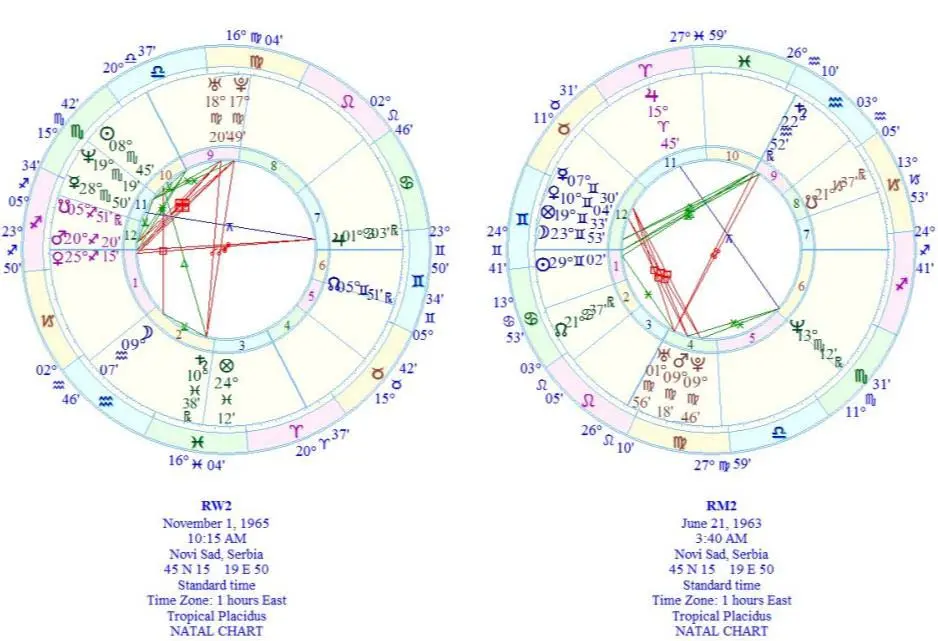
Consider a marriage in which the Venus and Moon contacts initially create a strong sense of attraction and familiarity, but additional Venus contacts reveal why the relationship later becomes difficult. This type of chart demonstrates why a single pleasant aspect should never be interpreted in isolation.
The Woman's Moon and Venus
The woman's Moon at 9° Aquarius falls in the man's 9th house. This house placement does not by itself describe the most typical pattern for marriage, although the couple may experience greater emotional closeness through travel, distance, or experiences outside their ordinary environment. In a relationship chart, the absence of a classic 1st-, 7th-, or 5th-house Moon placement does not invalidate the relationship; it simply changes the way emotional closeness is expressed.
Her Moon forms a trine to his Mercury–Venus conjunction. Because Mercury rules his Ascendant, this contact gives a strong indication that he could have felt familiar and emotionally accessible to her from the beginning. Communication could also have been intimate and supportive, allowing the two to confide in each other.
At the same time, her Moon forms an exact quincunx to his Mars. This introduces a much more difficult emotional dynamic. The Moon represents vulnerability, emotional needs, and the need for care, while Mars can operate through force, impatience, or confrontation. In the actual relationship, significant emotional and later physical hurt occurred, particularly around the birth of their daughter. The Moon–Mercury/Venus harmony nevertheless helped preserve communication between them because of their child. The same lunar symbolism also appeared when she cared for him after an accident and he stayed with her for almost two weeks.
Her Venus at 25° Sagittarius falls directly on his Descendant. This is a strong partner contact: Venus on the Descendant can make the Venus person readily recognizable as a potential partner and can contribute to attraction. Her Venus is also a natural significator of relationship matters and represents her through its connection with her Ascendant.
However, this Venus opposes his Moon and also opposes his Sun. The attraction represented by Venus on the Descendant therefore does not guarantee marital satisfaction. The relationship could function more comfortably during courtship than after marriage, when the lunar themes of emotional security, domestic life, and motherhood became much more prominent. The difficult Venus contacts indicate that her expectations of the relationship were not ultimately fulfilled.
The Man's Moon and Venus
The man's Moon lies exactly on her Descendant. This is a significant synastry contact because the Moon person can naturally perceive the Descendant person through a partnership-oriented lens. It is common to find the Moon or Venus of one partner near the Ascendant or Descendant of the other in romantic and marital relationships.
His Moon opposes her Venus–Mars conjunction. The Venus opposition contributes to dissatisfaction in affection and emotional needs, while the Mars opposition adds a more confrontational layer. He could experience her as excessively forceful or constantly active, particularly because her Mars is on her Ascendant. He described the relationship as feeling like a continuous race, which corresponds closely with the active Mars symbolism.
There is also natal confirmation on her side. Her 7th-house ruler is Mercury in Scorpio, pointing toward strong emotional intensity and jealousy in partnership matters. Its dispositor, Mars, forms a square to Pluto–Uranus, reinforcing the difficult relationship pattern shown in her natal chart. The synastry therefore does not create the entire problem by itself; it activates themes already present in her horoscope.
The Man's Venus and the Long-Term Problem
His Venus at 10° Gemini falls in her 6th house. This is not generally an easy house placement for Venus unless the relationship is connected with work or employment. The 6th house can also be considered the 12th from the 7th, which introduces the possibility of concealed matters within the partnership.
This interpretation gains additional support from his natal Venus in Gemini in the 12th house, which already contains a predisposition toward parallel or hidden relationship themes. The synastry placement therefore reinforces rather than independently creates that tendency.
His Venus forms a trine to her Moon, providing an initially supportive emotional connection. However, Venus also forms a square to her Saturn. The Saturn contact is less likely to dominate the first stage of the relationship because the harmonious lunar contact is easier to experience immediately. Over time, however, Saturn can reveal restriction, dissatisfaction, obligation, and a relationship that carries a sense of unresolved responsibility.
This combination illustrates an important principle in synastry: early attraction and emotional compatibility do not necessarily describe the entire lifespan of a relationship. A relationship can begin with strong Venus, Moon, and Descendant contacts while later becoming increasingly shaped by difficult Saturn, Mars, or other challenging configurations. For a wider framework on evaluating individual synastry factors, see this guide to physical attraction in synastry.
Integrating Venus Aspects in Synastry
Venus should therefore be assessed as part of the complete synastry structure rather than treated as an isolated indicator of love. Harmonious Venus contacts can show attraction, enjoyment, cooperation, shared tastes, and affection, while difficult contacts can reveal dissatisfaction, conflicting preferences, excessive passion, or unmet expectations.
The most useful interpretation comes from comparing Venus with the other personal planets and with the houses and natal conditions involved. A harmonious aspect may explain why two people enjoy one another at first, while a difficult contact may explain what becomes problematic as the relationship develops. Conversely, a challenging Venus aspect does not automatically prevent a relationship; its meaning depends on the wider pattern and on the other factors that connect the two people.
Synastry Moon and Venus: How Closeness Develops
When interpreting synastry, it is useful to distinguish between the factors that create emotional closeness and those that create attraction, affection, or enjoyment. The Moon is especially important for understanding how one person experiences another as familiar, safe, and emotionally accessible. Venus adds pleasure, affection, appreciation, and the desire to share enjoyable experiences.
The house placement of a partner's Moon can show the life area through which emotional connection is experienced. For example, a Moon falling into the 4th house can make closeness particularly noticeable in domestic life, while a Moon in the 5th house can connect emotional warmth with children, recreation, romance, and shared enjoyment. House overlays therefore need to be considered alongside the actual interplanetary aspects. A broader discussion of this principle can be found in synastry house overlays.
How the Moon Creates a Sense of Closeness
In synastry, the Moon functions as the receptive principle. We do not simply experience the other person's Moon in isolation; our own Moon responds to the partner's planets and to the houses activated by the partner's chart. A supportive aspect from our Moon to one of the partner's planets can therefore provide a direct channel through which emotional familiarity develops.
This distinction is important when interpreting a relationship. The planet receiving our Moon's contact can describe what the other person does that allows us to feel emotionally connected. Likewise, the house into which the partner's Moon falls can indicate the circumstances in which their presence feels most intimate or familiar.
A Long-Term Marriage Example
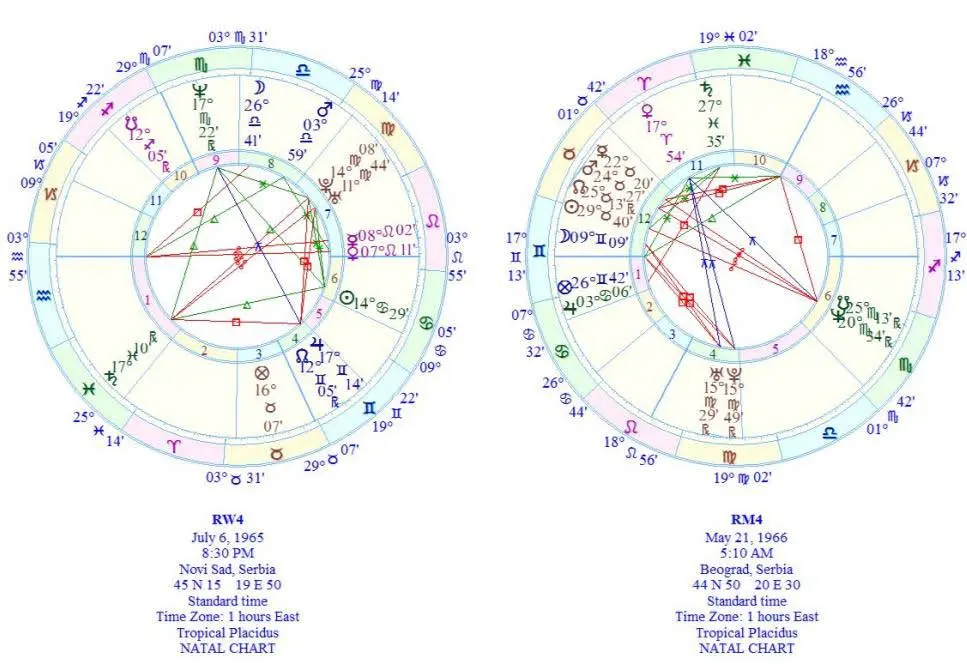
Consider a couple who have remained married for approximately two decades. Their synastry demonstrates why Moon and Venus contacts should be interpreted from both directions rather than judging the relationship from only one person's planets.
The woman's Moon at 26° Libra falls in the man's 5th house. This is supportive for a combination of affection, emotional warmth, romance, children, and shared recreation. However, her Moon does not form aspects to his personal planets. Consequently, the 5th-house overlay provides an important channel for connection, but the Moon itself is not strongly integrated with his personal planetary pattern.
The 5th-house placement suggests that emotional closeness can become particularly noticeable through activities associated with this house. Spending leisure time together, going out, enjoying entertainment, or sharing experiences involving children can strengthen the sense of connection. The arrival of children may therefore become an especially important stage in how emotional closeness is experienced.
The woman's Venus at 7° Leo falls in his 3rd house. This favors enjoyment of conversation, everyday interaction, and short journeys together. Her Venus also forms a sextile to his Moon, creating a direct connection between affection and emotional receptivity. This is a useful indicator of warmth because one person's Venus can provide the pleasant, affectionate quality through which the other's Moon feels comfortable.
The Man's Moon and Emotional Security
The man's Moon falls in the woman's 4th house. This places his lunar principle directly into an area associated with home, family, roots, and private emotional life. The relationship can therefore become particularly intimate through domestic life and the experience of sharing a home.
His Moon also forms a sextile to her Venus, reinforcing the affectionate connection already visible from the opposite direction. In addition, his Moon sextiles her Mercury. This adds an important communicative dimension: emotional experiences can be discussed openly, personal matters can be shared, and each person can more easily understand what the other is trying to express.
When several lunar contacts support one another in this way, the relationship can develop a strong sense of familiarity even when individual aspects elsewhere in the synastry are difficult. This is one reason the astrologer should examine the complete network of contacts rather than judging one aspect independently.
Venus, Expectations, and Relationship Satisfaction
The man's Venus falls in the woman's 2nd house. This overlay can connect his affection with her sense of value, security, possessions, and material comfort. One possible expression is generosity through gifts or other tangible demonstrations of affection.
However, his Venus forms a square to her Sun. The Sun–Venus tension can indicate a difference between what one person expects from the relationship and what the other naturally provides. Attraction may exist while satisfaction remains incomplete. In this particular chart, the symbolism becomes more significant because his Venus rules his 12th house while her Sun rules her 7th, bringing themes of partnership and hidden or private matters into the same configuration.
This illustrates why a pleasant house overlay should not automatically be interpreted as proof of relationship harmony. A planet can operate positively through a house while its aspects introduce another layer of experience. The astrologer needs to combine the overlay, planetary symbolism, and aspects before reaching a judgment.
Finding the Strongest Synastry Connection
When several contacts exist between two charts, the astrologer must determine which ones have the greatest weight. Exact aspects between personal planets deserve particular attention, with conjunctions often standing out as especially powerful points of contact.
The most exact aspect is not automatically the only important factor, but a very close personal-planet connection usually provides a strong indication of how the two charts directly interact. This is particularly useful when comparing several possible explanations for why two people remain connected over time.
Rather than counting every aspect equally, examine the strongest contacts first and then determine how the remaining aspects modify them. This prevents a long list of minor contacts from obscuring the principal relationship dynamics. The relative importance of different synastry contacts is discussed further in this guide to important synastry aspects.
What Sun Aspects Reveal in Synastry
The Sun describes will, creative expression, confidence, vitality, and the way a person asserts their individuality. When the Sun forms an aspect with another person's personal planet, it influences how the two individuals affect one another's confidence, self-expression, and ability to pursue what they want.
Sun contacts therefore become particularly important when studying cooperation, authority, ambition, creative activity, and conflicts of will. Their expression changes considerably depending on whether the aspect is harmonious or difficult.
Sun–Sun Synastry
A harmonious Sun–Sun aspect generally indicates that the two people can recognize and support each other's basic nature. Their personalities tend to be easier to coordinate, and they may encourage one another to express their abilities rather than constantly competing for recognition.
- Their basic approaches to life can be compatible.
- They are more likely to respect one another's wishes and individuality.
- Creative ideas can receive mutual encouragement.
- Confidence can increase through positive reinforcement from the other person.
A difficult Sun–Sun aspect creates a different dynamic. The individuals may have incompatible styles of self-expression or may both insist on having their own way. Because the Sun is connected with will and personal authority, neither person may readily accept the other's direction.
- Differences in character become more visible.
- Ego conflicts can develop.
- Both people may attempt to impose their preferences.
- Competition can replace cooperation.
- Authority conflicts may become especially significant in parent–child relationships or professional situations.
In a parent–child relationship, this configuration deserves particular attention because the child must learn how to respond to authority while developing an independent identity. Persistent refusal to recognize legitimate authority can later become a recurring difficulty in other relationships.
Sun–Mercury: Communication and Recognition
A harmonious Sun–Mercury aspect supports conversation, intellectual exchange, advice, and the sharing of ideas. The Sun can give Mercury greater clarity and direction, while Mercury provides language through which the Sun's ideas and intentions can be articulated.
- Conversation can become an important part of the relationship.
- The two people may enjoy spending time together through discussion.
- Advice can be more readily accepted.
- Creative or practical ideas can develop through interaction.
- The aspect can be especially useful in teacher–student and parent–child relationships.
There is also an element of recognition in this aspect. When the Sun person speaks, the Mercury person may give greater weight to what is being said. This can make instruction, guidance, and intellectual cooperation easier.
A difficult Sun–Mercury aspect can instead produce mental friction. Because both planets participate in conscious expression, disagreement can become personal. Mercury may challenge the Sun's authority through words, criticism, or dismissive comments, while the Sun may reject Mercury's ideas as unimportant.
- Communication may produce misunderstanding.
- Words can undermine confidence or authority.
- One person's ideas may be repeatedly dismissed by the other.
- Arguments can become struggles over whose viewpoint deserves recognition.
Sun–Mars: Motivation, Competition, and Conflict
The Sun–Mars aspect combines will with action. When harmonious, this can be one of the most productive combinations for people who need to accomplish something together. The Sun provides direction and intention, while Mars supplies the energy required to act on that intention.
- The two people can energize one another.
- Confidence and determination are reinforced.
- Ambitions receive practical support.
- One person can encourage the other to persist when difficulties arise.
- Friendly competition can stimulate performance without necessarily becoming hostile.
- Mars can translate the Sun's plans into concrete action.
- Romantic relationships may also experience heightened passion.
This combination can be particularly effective when two people are pursuing a common goal. The Sun contributes the strategic or directional principle, while Mars is more willing to initiate and execute. Mutual encouragement can therefore become one of the defining strengths of the aspect.
With a difficult Sun–Mars conjunction, square, or opposition, the same energy can become confrontational. Instead of supporting one another's will, the two people may compete over whose wishes should prevail.
- Arguments and confrontational behavior can increase.
- Each person may insist on their own position.
- Competition can become a struggle for control.
- Authority may be challenged.
- Pride and stubbornness can make compromise difficult.
- In extreme expressions, hostility or aggressive behavior can develop.
The key distinction is whether Mars is functioning as an instrument for the Sun's aims or as an opposing force. In the harmonious version, action strengthens the other person's confidence and helps transform intention into results. In the difficult version, the same drive can become a direct challenge to the other person's authority and individuality.
When interpreting these aspects in practice, the strongest contacts should be identified first and then compared with the house overlays and the natal condition of the planets involved. This broader method is essential because the same Sun, Moon, Venus, or Mars aspect can operate very differently depending on the rest of the synastry pattern. A systematic approach to combining these factors is presented in the synastry aspects interpretation guide.
Synastry Mercury Aspects with Personal Planets
Synastry Mercury aspects describe communication between two people and how well they can be practical together.
A favorable synastry aspect between Mercury and Mercury indicates:
- mental compatibility
- exchange of ideas
- shared interests
- effective cooperation in writing, education, as well as travel
An unfavorable synastry aspect between Mercury and Mercury indicates:
- different mental processes (people process information differently, which leads to arguments and criticism. For example, if one person has Mercury in Aquarius and the other Mercury in Taurus and they are in a square, the first person will not understand at all why it takes the second person so much time to process information, when it can be done in a fraction of a second, while the second person will be annoyed that the first person is fast and skips steps when explaining)
- arguments and criticism
- opposing viewpoints
Mercury and Mars Synastry Aspects
A favorable synastry aspect between Mercury and Mars (trine or conjunction) indicates:
- a lot of conversation
- constructive discussions and criticism
- healthy exchange of ideas
- good potential for working together
Here, Mercury will suggest something, and Mars will take action. Even if some criticism occurs, Mars does not have a problem with it here and will immediately understand it as constructive criticism and put the suggestion into action.
An unfavorable synastry aspect between Mercury and Mars (conjunction, square, and opposition) indicates:
- arguments, insults, criticism, nervousness
- looking for mistakes
- people do not inform each other about their activities
- they criticize each other because of mistakes
Synastry Mars Aspects
Synastry aspects involving Mars indicate:
- actions
- physical activities
- competition
- sexuality
A favorable synastry aspect between Mars and Mars indicates:
- cooperation in achieving common goals
- strong sexuality
An unfavorable synastry aspect between Mars and Mars (conjunction, square, and opposition) indicates:
- differences in actions, which is unfavorable for shared work and activities
- conflicts, arguments, hostility, physical confrontations
It is very difficult when two people need to do something together with such a poor synastry combination because their actions will not be coordinated, they will not work at the same pace, they will not want to work in the same way, and conflict will arise very quickly.
Want a Personal Astrology Reading?
Get a personal astrology consultation based on your own chart.
Get a Personal ReadingIf this lesson was helpful, you may support the work and help keep all content freely available.
Support the Work